
Essay on poem by Adam Donaldson Powell & Azsacra Zarathustra: Symbolism, Archetypes, and the Politics of Hidden Power and the sci-fi novel The tunnel at the end of time
The collaborative poetic universe of Adam Donaldson Powell and Azsacra Zarathustra presents a dense, visionary critique of modern civilization, one that resonates strongly with geopolitical tensions between Russia and the United States. Their “extreme poetry” operates not merely as aesthetic experimentation, but as a philosophical and prophetic discourse, exposing a world where surface-level conflict conceals deeper structures of power, illusion, and complicity. Through rich symbolism, archetypal figures, and philosophical echoes—particularly those reminiscent of Nietzsche—the poem interrogates both the spiritual crisis of humanity and the dangerous ambiguity of global politics.
At its core, the poem portrays humanity as self-destructive and morally disoriented. One striking idea describes humankind as a “predator out-of-control” and a “soul-virus,” suggesting that the true threat to global security is not external enemies but the internal corruption of human values . This image functions symbolically on multiple levels. Politically, it reflects the mutual suspicion between Russia and the United States—two superpowers historically locked in cycles of rivalry, deterrence, and ideological opposition. Yet the poem subverts the binary: instead of assigning blame to one side, it suggests that both are manifestations of the same destructive archetype. The “enemy” is not the Other, but a shared pathology.
This idea aligns with one of the poem’s most significant symbolic gestures: the collapse of the distinction between Christ and Antichrist, both of which are said to exist within the self . This duality functions as an archetype of moral ambiguity. In geopolitical terms, it reflects how nations publicly perform righteousness while privately engaging in ethically questionable strategies—covert operations, intelligence manipulation, or tacit agreements. The relationship between Russia and the United States is emblematic of this paradox: public antagonism often coexists with hidden cooperation, whether in arms control negotiations, backchannel diplomacy, or shared strategic interests. Thus, the poem anticipates a world where “sweet-sounding lies” distract populations from deeper dangers .
Symbolically, the poem’s recurring imagery of apocalypse—floods, disease, and collapse—serves as an archetype of purification and reckoning. These are not merely environmental or physical disasters but spiritual ones, reflecting what might be called a Nietzschean crisis: the death of old values without the emergence of new ones. Nietzsche’s concept of nihilism is clearly echoed in the poem’s fascination with “nothingness” and “void,” described as both terrifying and transformative . This philosophical influence is crucial. For Nietzsche, the collapse of traditional morality creates both danger and opportunity—the possibility of either descent into chaos or the rise of the Übermensch, a figure who creates new values.
Azsacra Zarathustra, as a poetic persona, is itself an archetypal echo of Nietzsche’s Zarathustra—the prophet who descends from solitude to awaken humanity. Yet unlike Nietzsche’s figure, who proclaims the will to power, Azsacra’s message emphasizes inner transformation and responsibility. The line “Become the Divine Intervention” encapsulates this shift . Salvation will not come from external saviors—whether political leaders or divine forces—but from individual awakening. This idea carries profound implications for international relations. It suggests that systemic change cannot be imposed solely through treaties or power balances; it requires a transformation in the consciousness of those who wield power.
The poem’s archetypal structure also includes the Phoenix—a symbol of destruction and rebirth. This image reflects the cyclical nature of history, particularly in the context of U.S.-Russia relations, which have oscillated between hostility and cautious cooperation since the Cold War. Today, this cycle persists in new forms: cyber warfare, proxy conflicts, and ideological rivalry coexist with moments of negotiation and mutual dependence. The Phoenix thus becomes a symbol of both hope and warning—renewal is possible, but only through confronting the ashes of past failures.
Importantly, the poem critiques not only political elites but also the masses. The “deception of the ignorant earth” suggests that populations themselves are complicit, seduced by narratives that obscure reality . This resonates strongly with the contemporary media landscape, where misinformation, propaganda, and selective truth-telling shape public perception. In this sense, the poem anticipates a world where disagreement is often performative, while real decisions are made in secrecy—a dynamic that undermines democratic accountability and increases the risk of conflict.
Philosophically, the poem can be seen as synthesizing Nietzschean nihilism with Eastern concepts such as Zen and “shunya” (emptiness), described as a path toward inner revolution . This fusion creates a unique ethical framework: rather than despairing in the face of nothingness, the poem invites a creative engagement with it. Emptiness becomes a space for transformation, not annihilation. Applied to global politics, this suggests that the breakdown of old certainties—such as clear ideological divisions—could be an opportunity for reimagining international relations, if approached consciously.
In conclusion, the poem’s vision of the relationship between Russia and the United States transcends simple opposition. Through its symbolic language, archetypal structures, and philosophical depth, it reveals a world where visible conflicts mask deeper unities—and where the greatest danger lies not in open disagreement but in hidden convergence. By invoking Nietzsche and spiritual traditions alike, the poem challenges both individuals and nations to confront their own contradictions. In doing so, it offers a stark warning: without inner transformation, the cycles of deception and destruction will continue, threatening not only geopolitical stability but the very future of humanity.
The sci-fi thriller The Tunnel at the End of Time by Adam Donaldson Powell is less a conventional narrative than a hybrid work—part speculative fiction, part philosophical drama, part spiritual manifesto. Beneath its surface of apocalyptic tension and conspiratorial intrigue lies a deeper inquiry into the human psyche, collective destiny, and the symbolic structures through which we interpret crisis. When read through the lenses of archetypal criticism and Jungian theory, the story reveals itself as a psychological map of late modern anxiety: a world haunted by visions of collapse, yet equally sustained by fantasies of salvation.
At the narrative level, the work engages with familiar elements of conspiracy culture: shadowy power structures, geopolitical tensions, and the specter of a “New World Order.” As one critical summary notes, the text situates itself within a post-apocalyptic framework shaped by global conflict and moral decay . These themes resonate strongly with contemporary discourse. In an era marked by distrust in institutions, digital misinformation, and polarized political realities, conspiracy thinking has become not merely fringe but culturally pervasive. Powell’s fictional universe amplifies these tendencies, transforming them into a mythic structure in which humanity confronts its own shadow.
From a Jungian perspective, this emphasis on conspiracy can be understood as a projection of the Shadow—that repressed, unacknowledged dimension of the psyche described by Carl Jung. The “enemy” in such narratives—whether framed as elites, hidden rulers, or demonic forces—is rarely just external. Instead, it symbolizes aspects of the self or the collective that have been denied or disowned. The text itself gestures toward this interpretation when it suggests that the true “antichrist” is not an external entity but humanity itself, driven by greed, imbalance, and moral blindness . In Jungian terms, this is the moment when projection begins to collapse, and the individual—or society—is forced to confront its own complicity in its downfall.
Yet the story does not remain in the register of darkness. Running parallel to its dystopian imagery is a persistent hope: the belief in “angels” or “good elements” that may intervene to save the world. These figures function as archetypes of the Self—the organizing principle of wholeness in Jungian psychology. They represent not merely external saviors but the latent potential for integration within the psyche. The tension between despair and redemption thus mirrors the Jungian process of individuation, in which the individual must navigate chaos, fragmentation, and contradiction in order to achieve a more complete sense of being.
Importantly, Powell complicates the notion of divine intervention. Rather than offering a simplistic narrative of rescue, the text suggests that salvation is contingent upon inner transformation. As one commentary observes, the solution to societal disintegration is not external intervention but a deeper reckoning with human behavior and consciousness . This aligns closely with Jung’s insistence that meaningful change occurs not through projection onto external authorities—whether political or spiritual—but through the integration of unconscious material into conscious awareness.
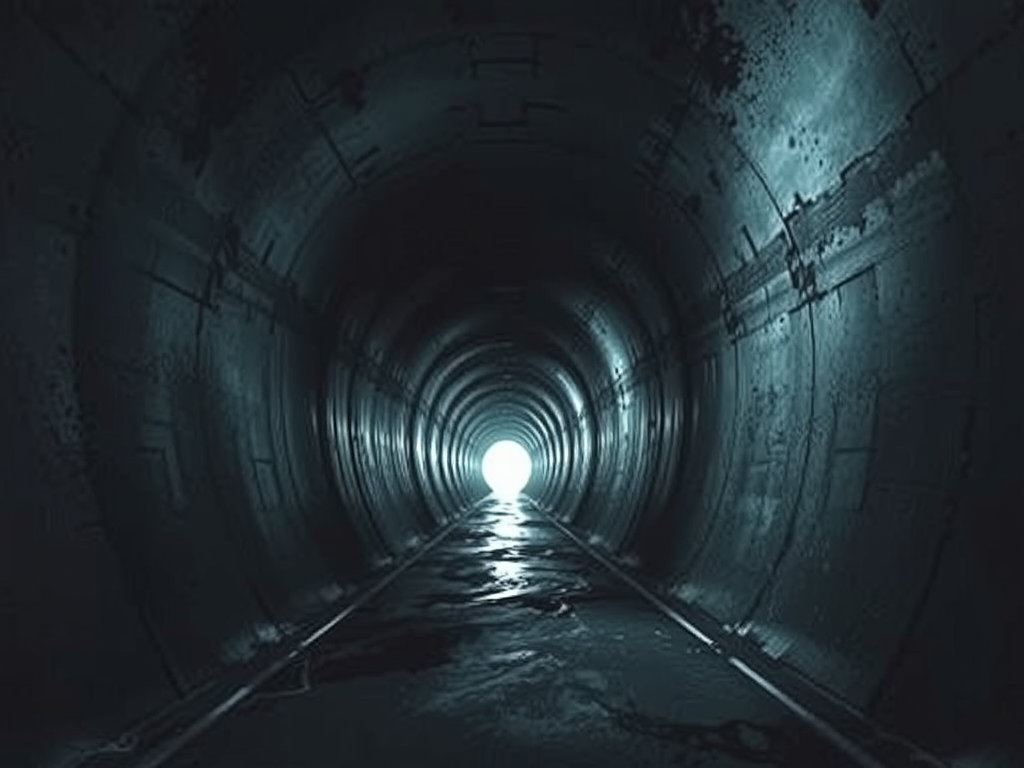
The “tunnel” of the title serves as a central metaphor that can be fruitfully interpreted in archetypal terms. Tunnels are liminal spaces: passages between worlds, states, or identities. In mythological and psychological frameworks, they often symbolize the journey into the unconscious—a descent into darkness that precedes rebirth. The “end of time” further intensifies this symbolism, suggesting not only an apocalyptic endpoint but also a suspension of linear temporality. In Jungian thought, such moments correspond to encounters with the timeless dimension of the psyche, where archetypal patterns transcend historical context.
This symbolic structure becomes particularly relevant when related to current events. The early 21st century has been characterized by overlapping crises—pandemics, climate change, geopolitical instability—that collectively produce a sense of living at “the end of time.” At the same time, there has been a resurgence of spiritual discourse, alternative belief systems, and apocalyptic narratives. Powell’s work can be read as both a reflection of and a response to this condition. It captures the psychological atmosphere of a world in transition, where old certainties have collapsed and new meanings have yet to fully emerge.
The interplay between conspiracy and spirituality in the text also reflects a broader cultural pattern. In many contemporary movements, distrust of institutional authority coexists with a heightened interest in mystical or esoteric ideas. This combination can be seen as an attempt to re-enchant a disenchanted world—to restore a sense of meaning and agency in the face of perceived chaos. In Jungian terms, it represents the activation of archetypal material that had been suppressed by modern rationalism. However, as Jung warned, such material can be both creative and destructive, depending on how it is integrated.
Powell’s narrative appears acutely aware of this ambivalence. On one hand, it acknowledges the seductive power of grand, totalizing explanations—whether framed as conspiracies or spiritual revelations. On the other hand, it repeatedly returns to the theme of self-responsibility. The ultimate struggle is not between external forces of good and evil but within the human psyche itself. This insight elevates the work beyond genre fiction, positioning it as a form of existential inquiry.
The presence of angels and higher beings in the story can also be interpreted through the archetype of the Guide or Wise Old Man/Woman. These figures often appear in moments of crisis, offering insight or direction. Yet in Jungian analysis, they are not autonomous entities but personifications of inner wisdom. Their function is to mediate between conscious and unconscious realms, facilitating the process of transformation. In this sense, the “good elements” in Powell’s narrative may be understood as symbolic expressions of humanity’s capacity for self-awareness and moral evolution.
At the same time, the text does not shy away from depicting the difficulty of this process. The imagery of destruction, disease, and moral decay underscores the cost of failing to integrate the shadow. It suggests that without conscious effort, the darker aspects of human nature will manifest collectively, leading to societal collapse. This theme is particularly resonant in light of contemporary challenges, where issues such as environmental degradation and political polarization can be seen as externalizations of deeper psychological conflicts.
In conclusion, The Tunnel at the End of Time operates on multiple levels: as a sci-fi thriller, as a critique of contemporary society, and as a symbolic exploration of the human psyche. Its engagement with conspiracy theories and apocalyptic visions reflects the anxieties of our time, while its emphasis on inner transformation aligns with Jungian concepts of individuation and archetypal integration. The “tunnel” becomes a powerful metaphor for the journey through darkness toward potential renewal—a journey that is both collective and deeply personal. Ultimately, the work suggests that the hope for salvation, whether framed in terms of angels or “good elements,” lies not in external rescue but in the difficult, ongoing task of confronting and integrating the full complexity of what it means to be human.
Read it here:
Leave a Reply