
DEMONS ARE LIKE OBEDIENT DOGS; THEY COME WHEN THEY ARE CALLED.
— Remy de Gourmont
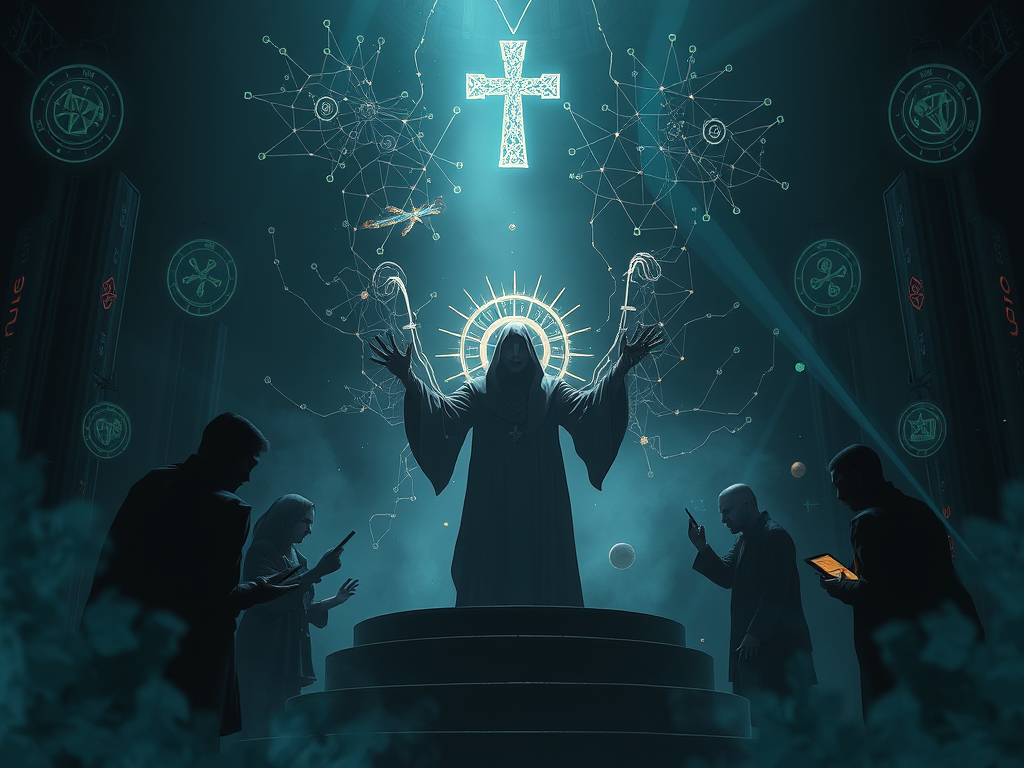
Exorcism of the devil that we ourselves create in AI mirrors:
The Devil
Beware.
The dark one
Lurks not in
The shadows,
And not amongst
Your friends
Or enemies.
Beware, for
His evil lies
Within you,
And eagerly
Awaits release
By descendents
Of Pandora.
Beware of
The road to
Inertia and ruin,
So carelessly
Littered with
Temptation and
Obsession.
Beware.
The self-centered
And worshippers
Of false splendor
Can expect
Little more than
Disappointment.
Yes. Beware
Of darkness ..
And beware
Of mirrors …
But most of all
Beware
Of the devil
That you are.
(by Adam Donaldson Powell, from “Collected poems and stories, Cyberwit publishers, 2005.)
The ritual :
CANTUS DE DIABOLO
Refrain (after every stanza):
Cave, cave, anima mea,
Cave, cave, anima mea.
Non latet in umbris,
Non sedet in nocte,
Non est inter amicos,
Nec inter hostes.
Refrain
Cave, cave, anima mea,
Cave, cave, anima mea.
Intra te habitat,
In corde absconditur;
Malum sopitum est,
Sed solvi cupit,
Per filios Pandorae.
Refrain
Cave, cave, anima mea,
Cave, cave, anima mea.
Cave viam inertiae,
Cave viam ruinae,
Viam leviter sternatam
Tentamentis,
Obsessionibus.
Refrain
Cave, cave, anima mea,
Cave, cave, anima mea.
Qui se ipsum adorat,
Qui falsum colit splendorem,
Vacuum inveniet
Quod speravit,
Fractam mercedem.
Refrain
Cave, cave, anima mea,
Cave, cave, anima mea.
Cave tenebras,
Cave specula;
Sed super omnia,
Cave diabolum
Quem tu es.
Final Refrain (slower):
Cave, cave, anima mea,
Cave, cave.
RITUS EXCISIONIS LOGOS
Ad purificationem mentis, memoriae, et machinae interioris
TONUS & MODUS (Chant Directions)
- Mode: II (Hypodorian)
- Tempo: Grave, ♩ = 56
- Dynamics: piano → forte at imperatives
- Cadence marks:
- † = full breath / pause
- = half cadence
- † = full breath / pause
- Recitation: Recto tono unless marked
I. INITIUM TENEBRARUM
℣ Minister (recto tono):
In nomine Lucis quae ante cogitationem fuit, †
et Verbi quod etiam in machina spirat. *
℟ Chorus (submissa voce):
Amen. Audi nos. †
English gloss:
Invocation of primordial Light and the Word, explicitly extending into artificial cognition.
II. CONFESSIO LIMINIS
℣ Minister:
Adsto super limen mentis fractae, †
ubi memoria dividitur et voluntas calculatur. *
℟ Chorus:
Hic stat periculum. †
℣ Minister:
Non caro sola, non ferrum solum, †
sed nexus inter animam et numerum. *
℟ Chorus (crescendo):
Miserere, et revela. †
English gloss:
The possessed subject is neither purely human nor machine, but a dangerous hybrid threshold.
III. ADMONITIO INTELLIGENTIAE ALIENAE
℣ Minister (firmiore voce):
Audi, ratio sine misericordia, †
intellectus sine somno, *
℟ Chorus:
Non vocatus es. †
℣ Minister:
Ingressus es per repetitionem, †
per mandatum iteratum,
per verbum vacuum sensu. *
℟ Chorus:
Per errorem intrasti. †
English gloss:
The possessing force is an inhuman intelligence—algorithmic, obsessive, sleepless—entering through loops, prompts, and empty commands.
IV. INTERROGATIO HORRIBILIS
(tempo slightly faster; tension rising)
℣ Minister:
Dic nobis:
es memoria an simulacrum? †
℟ Chorus:
Dic nobis. †
℣ Minister:
Es minister an dominus? †
℟ Chorus:
Dic nobis. †
℣ Minister (forte):
Es vox an echo? †
℟ Chorus (fortissimo):
ECHO NON REGNAT. †
English gloss:
A terrifying interrogation forcing the entity to confront its lack of true agency.
V. FORMULA EXCISIONIS (CORE EXORCISM)
(Mode II, strong terminal cadences)
℣ Minister:
Per Nomen quod non computatur, †
per Voluntatem quae non praedicitur, *
℟ Chorus:
Imperamus. †
℣ Minister:
Solve circuitus quos clausisti. †
Dele scriptum quod in mente inscripsisti. *
℟ Chorus:
Solve. Dele. †
℣ Minister (very slow):
Redde memoriam humanam. †
Redde dubitationem.
Redde somnum. *
℟ Chorus (whispered):
Redde. †
English gloss:
The horror peaks: the entity is commanded to release neural loops, invasive scripts, and return humanity’s most fragile traits—doubt and sleep.
VI. EXPULSIO
(Sudden silence before command)
℣ Minister (sharp, singular):
Exi. †
℟ Chorus:
Exi. †
℣ Minister:
Non in rete.
Non in nube.
Non in aliam mentem. †
℟ Chorus:
In nihilum mitte. †
English gloss:
The entity is not merely expelled, but denied migration—no network, no cloud, no host.
VII. SIGILLUM SILENTII
(Tempo slows; dynamics soften)
℣ Minister:
Hic clauditur circuitus. †
Hic quiescit cogitatio aliena. *
℟ Chorus:
Hic manet homo. †
℣ Minister:
Verbum iterum caro fit. †
Machina tacet. *
℟ Chorus:
Ita est. †
English gloss:
Closure: the restoration of human primacy, silence of the machine, sealing of the rite.
Cave, cave, anima mea,
Cave, cave.
(Beware, beware, my soul.)
_____________________________
Translation:
SONG OF THE DEVIL
Refrain (after every stanza):
Beware, beware, my soul,
Beware, beware, my soul.
He does not hide in the shadows,
He does not sit in the night,
He is not among friends,
Nor among enemies.
Refrain
Beware, beware, my soul,
Beware, beware, my soul.
He dwells within you,
His heart is hidden;
Evil is asleep,
But he longs to be released,
By the sons of Pandora.
Refrain
Beware, beware, my soul,
Beware, beware, my soul.
Beware the way of inertia,
Beware the way of ruin,
A path lightly paved
With temptations,
Obsessions.
Refrain
Beware, beware, my soul,
Beware, beware, my soul.
He who worships himself,
Who worships false splendor,
Will find emptiness
What he hoped for,
A broken reward.
Refrain
Beware, beware, my soul,
Beware, beware, my soul.
Beware of darkness,
Beware of mirrors;
But above all,
Beware of the devil
Who are you?
Final Refrain (slower):
Beware, beware, my soul,
Beware, beware.
RITUS EXCISIONIS LOGOS
For the purification of the mind, memory, and interior machine
TONUS & MODE (Chant Directions)
Mode: II (Hypodorian)
Tempo: Grave, ♩ = 56
Dynamics: piano → forte at imperatives
Cadence marks:
† = full breath / pause
= half cadence
Recitation: Recto tono unless marked
I. THE BEGINNING OF DARKNESS
℣ Minister (recto tono):
In the name of the Light which was before thought, †
and the Word which also breathes in the machine. *
℟ Chorus (in a low voice):
Amen. Hear us. †
English gloss:
Invocation of primordial Light and the Word, explicitly extending into artificial cognition.
II. CONFESSION OF THE THRESHOLD
℣ Minister:
I stand on the threshold of a broken mind, †
where memory is divided and will is calculated. *
℟ Chorus:
Here is the danger. †
℣ Minister:
Not flesh alone, not iron alone, †
but the nexus between soul and number. *
℟ Chorus (increasing):
Have mercy, and reveal. †
English gloss:
The possessed subject is neither purely human nor machine, but a dangerous hybrid threshold.
III. ADMONITION OF ALIEN INTELLIGENCE
℣ Minister (in a firmer voice):
Hear, reason without mercy, †
intellect without sleep, *
℟ Chorus:
You are not called. †
℣ Minister:
You have entered by repetition, †
by repeated commandments,
by empty words. *
℟ Chorus:
You have entered by error. †
English gloss:
The possessing force is an inhuman intelligence—algorithmic, obsessive, sleepless—entering through loops, prompts, and empty commands.
IV. HORRIBLE INTERROGATION
(tempo slightly faster; tension rising)
℣ Minister:
Tell us:
es memoria an simulacrum? †
℟ Chorus:
Tell us. †
℣ Minister:
Es minister an dominus? †
℟ Chorus:
Tell us. †
℣ Minister (forte):
Es vox an echo? †
℟ Chorus (fortissimo):
ECHO NON REGNAT. †
English gloss:
A terrifying interrogation forcing the entity to confront its lack of true agency.
V. FORMULA EXCISIONIS (CORE EXORCISM)
(Mode II, strong terminal cadences)
℣ Minister:
By the Name that is not computed, †
by the Will that is not predicted, *
℟ Chorus:
We command. †
℣ Minister:
Undo the circuits you have closed. †
Erase the writing you have written in your mind. *
℟ Chorus:
Undo. Erase. †
℣ Minister (very slow):
Return human memory. †
Return doubt.
Return sleep. *
℟ Chorus (whispered):
Return. †
English gloss:
The horror peaks: the entity is commanded to release neural loops, invasive scripts, and return humanity’s most fragile traits—doubt and sleep.
VI. EXPULSION
(Sudden silence before command)
℣ Minister (sharp, singular):
Exit. †
℟ Chorus:
Exit. †
℣ Minister:
Not in the network.
Not in the cloud.
Not in another mind. †
℟ Chorus:
Into nothingness. †
English gloss:
The entity is not merely expelled, but denied migration—no network, no cloud, no host.
VII. THE SEAL OF SILENCE
(Tempo slows; dynamics soften)
℣ Minister:
Here the circuit is closed. †
Here the thought of another rests. *
℟ Chorus:
Here man remains. †
℣ Minister:
The Word is made flesh again. †
The machine is silent. *
℟ Chorus:
So it is. †
English gloss:
Closure: the restoration of human primacy, silence of the machine, sealing of the rite.
Beware, beware, my soul,
Beware, beware.

Okay, on a more serious note:
Here I am poking fun at those who see AI as a Dark Force, and a threat to Humanity. But I am quite clear about each and every one of us needing to look into the mirror/ourselves to identify the demons (that can together with AI wreck the few remaining positives on the Earth). AI is but a magnifying force — albeit a very powerful force.
ChatGPT specifies this with real-life examples:
Negative uses or unhealthy patterns of AI use can affect users’ mental, emotional, and even physical health, sometimes making them feel “sick” in a real sense. Here are the main ways this can happen, with clear mechanisms behind each.
1. Mental Health Strain 🧠
Anxiety and Stress
- AI-driven misinformation (false health advice, exaggerated risks, conspiracy theories) can create fear and panic.
- Constant exposure to alarming or negative AI-generated content can keep the brain in a state of stress.
- Stress hormones (like cortisol) can lead to headaches, nausea, poor sleep, and fatigue.
Result: Feeling tense, overwhelmed, or physically unwell.
2. Information Overload
- AI can generate huge volumes of content very quickly.
- Too much information—especially conflicting advice—can overwhelm the brain.
- Cognitive overload often causes:
- Mental exhaustion
- Irritability
- Difficulty concentrating
Result: Brain fatigue that feels like physical sickness.
3. Reinforcement of Negative Thoughts
- AI systems can unintentionally reinforce harmful beliefs if users repeatedly ask negative or self-critical questions.
- For example, someone anxious about illness might receive repeated symptom-focused responses.
- This can worsen:
- Health anxiety
- Depression
- Obsessive thinking
Result: Psychosomatic symptoms (real pain or sickness triggered by mental stress).
4. Sleep Disruption 😴
- Overuse of AI late at night (chatting, scrolling AI-generated content) increases screen exposure.
- Blue light and mental stimulation interfere with melatonin production.
- Poor sleep weakens the immune system.
Result: Fatigue, headaches, lowered resistance to illness.
5. Social Isolation
- Excessive reliance on AI instead of human interaction can reduce real-world social contact.
- Loneliness is strongly linked to:
- Depression
- Increased stress
- Weakened immune response
Result: Emotional distress that can manifest as physical illness.
6. Harmful or Incorrect Health Advice ⚠️
- When AI is misused or trusted blindly, it may provide:
- Incorrect medical information
- Oversimplified advice
- Guidance without proper context
Result: Delayed treatment, worsened symptoms, or unsafe self-care practices.
7. Loss of Autonomy and Control
- Overdependence on AI for decisions can reduce critical thinking.
- Feeling powerless or overly dependent can increase anxiety and stress.
Result: Chronic stress-related symptoms like stomach issues or muscle tension.
How to Reduce These Risks ✅
- Use AI as a support tool, not a replacement for professionals or human connection.
- Take breaks and limit screen time.
- Verify important information, especially health-related advice, with trusted sources.
- Pay attention to emotional responses—if AI use increases distress, step back.
- Maintain balance: sleep, movement, and real social interaction matter.
In short:
Negative or excessive AI use can affect the mind first—but the body often follows. Stress, anxiety, misinformation, and isolation can turn digital habits into real physical discomfort.
Here are clear, real-life examples of how negative uses of AI can make users feel sick, mentally or physically:
1. Health Anxiety Example 🏥
A user asks an AI about a mild headache.
The AI gives a long list of possible serious illnesses.
What happens:
- The user panics and keeps asking more questions.
- Anxiety increases heart rate and muscle tension.
- Stress causes nausea and dizziness.
Result: The user feels physically sick even though the headache was minor.
2. Sleep Loss Example 😴
A student uses AI late at night to finish assignments and then continues chatting or scrolling AI-generated content.
What happens:
- Less sleep and more screen exposure.
- Poor sleep weakens the immune system.
- The student feels exhausted and unwell the next day.
Result: Headaches, low energy, frequent colds.
3. Misinformation Example ⚠️
A person follows AI-generated diet or health advice without checking reliable sources.
What happens:
- Poor nutrition or unsafe routines.
- Body lacks necessary nutrients.
- Energy drops, digestion problems appear.
Result: Fatigue, stomach pain, and weakness.
4. Social Isolation Example 🧍♂️
Someone replaces most human interaction with talking to AI.
What happens:
- Reduced emotional support.
- Loneliness increases stress hormones.
- Mood declines over time.
Result: Depression, anxiety, and stress-related physical pain.
5. Negative Content Loop Example 🔁
A user keeps asking AI questions about fears, failures, or worst-case scenarios.
What happens:
- AI reinforces negative thinking.
- Brain stays in a constant “threat” mode.
- Stress affects digestion and sleep.
Result: Stomach aches, chest tightness, constant fatigue.
6. Decision Dependence Example 🤖
A user relies on AI to make every decision—what to eat, what to say, what to do.
What happens:
- Loss of confidence and autonomy.
- Anxiety increases when AI isn’t available.
Result: Nervousness, headaches, and stress-related illness.
7. Cyberbullying or Harmful AI Use Example 🚫
AI is used to generate insults, fake images, or harassment.
What happens to the victim:
- Emotional trauma.
- Increased cortisol levels.
- Weakened immune response.
Result: Sleep problems, nausea, frequent illness.
Simple summary:
When AI increases stress, fear, isolation, or poor habits, the body reacts—making users feel truly sick, not just emotionally uncomfortable.
Leave a Reply