
Strategies for a New World Order: Power, Legitimacy, and the Architecture of a Transformative Global Future
Throughout human history, the concept of a “new world order” has repeatedly emerged in moments of upheaval, crisis, and transition. Empires rise with promises of stability, prosperity, or divine mandate, only to consolidate power through coercion, assimilation, and hierarchical control. Whether under imperial Rome, colonial European powers, or modern geopolitical blocs, the structural logic has often been strikingly consistent: establish dominance through force or leverage, institutionalize authority, and maintain order through a combination of legitimacy narratives and strategic constraint.
In the modern era, especially following the devastation of global conflict, attempts have been made to move beyond raw power politics toward rules-based international systems. Institutions such as the League of Nations and later the United Nations were designed to mitigate conflict, facilitate cooperation, and provide frameworks for collective decision-making. Yet these institutions have struggled under the weight of the very forces they were meant to contain: competing national interests, asymmetric power distributions, and structural veto mechanisms that privilege a small number of dominant states.
Today, discussions of a “new world order” are once again resurfacing, driven by geopolitical fragmentation, technological transformation, ecological crisis, and shifting economic centers. The question is no longer whether global governance structures will evolve, but how. If the past is any guide, simply rebranding existing frameworks or replicating flawed institutional designs will not suffice. What is required is a fundamentally different approach—one that addresses the root causes of institutional failure while reimagining the principles of power, legitimacy, and global cooperation.
I. Historical Patterns: Power, Assimilation, and Legitimacy
Empires and dominant coalitions have historically relied on three interrelated strategies to establish and maintain control:
- Demonstration of Power: Military conquest, economic dominance, or technological superiority establishes the initial hierarchy.
- Institutionalization: Systems of governance, law, and administration formalize control.
- Cultural Assimilation: Narratives, education, and ideology reinforce legitimacy and suppress dissent.
These dynamics are evident across vastly different political systems. Monarchies justified rule through divine right, empires through civilizational superiority, and modern democracies through ideological frameworks such as liberalism or development. Despite differences in rhetoric, the structural outcome has often been similar: centralized authority with limited accountability to those outside the core power structure.
What distinguishes the modern era is the increasing awareness of these dynamics and the growing demand for more equitable and participatory forms of governance. However, awareness alone does not dismantle entrenched systems.
II. The Limits of Post-War International Institutions
The League of Nations represented the first major attempt to institutionalize collective security on a global scale. Its failure is often attributed to lack of enforcement mechanisms and the absence of key powers. However, more fundamentally, it suffered from a mismatch between its idealistic aspirations and the underlying realities of power politics.
The United Nations, established after the Second World War, sought to address these shortcomings by embedding enforcement authority within a Security Council dominated by major powers. This design acknowledged geopolitical realities but also codified inequality. The veto power granted to a small group of states has frequently paralyzed decision-making, particularly in conflicts involving those same powers or their allies.
This structural contradiction—between universal legitimacy and unequal authority—remains unresolved. While the UN has achieved significant successes in humanitarian coordination, peacekeeping, and norm-setting, it has struggled to act decisively in major geopolitical crises. The result is a growing perception of inefficacy, even as global challenges become more complex and interconnected.
III. The Problem of Power Distribution
Any future global governance system must confront a central question: how should power be distributed?
Traditional models offer several options, each with limitations:
- Power-Based Distribution: Authority reflects economic or military strength. While realistic, this perpetuates inequality and risks domination by a few.
- Equality-Based Distribution: Each state has equal representation. This promotes fairness but can lead to inefficiency and disconnect from material realities.
- Population-Based Distribution: Representation is proportional to population size. This introduces democratic legitimacy but raises concerns about minority rights and governance complexity.
A transformative approach would likely require a hybrid model that integrates multiple dimensions of legitimacy:
- Demographic Representation: Reflecting the global population.
- Economic Contribution: Recognizing resource capacity and interdependence.
- Regional Balance: Ensuring geographic diversity and preventing concentration of power.
- Functional Expertise: Incorporating non-state actors, scientific communities, and civil society.
Such a system would move beyond the state-centric paradigm that has dominated international relations, acknowledging that global challenges—climate change, pandemics, technological governance—transcend national boundaries and require broader participation.
IV. Rethinking Sovereignty
A major obstacle to effective global governance is the traditional concept of sovereignty as absolute and inviolable. While sovereignty has been essential in protecting states from external domination, it also limits collective action on issues that require coordinated responses.
A future world council would need to redefine sovereignty not as absolute autonomy, but as shared responsibility. This does not imply the dissolution of nation-states, but rather a layered system in which certain domains are governed collectively.
For example:
- Climate policy could be subject to binding global standards.
- Pandemic response could involve coordinated authority over resource allocation and data sharing.
- Cybersecurity could be regulated through international frameworks with enforcement mechanisms.
Such a shift would require a new social contract at the global level—one that balances local autonomy with global accountability.
V. Legal Authority and Enforcement
One of the key weaknesses of existing international institutions is the lack of enforceable legal authority. International law often relies on voluntary compliance, which is insufficient in high-stakes scenarios.
A new world council would need clearly defined legal powers, including:
- Binding Legislation in Specific Domains: Particularly those involving global commons or existential risks.
- Independent Judicial Mechanism: A body with authority to adjudicate disputes and interpret global law.
- Enforcement Capacity: Not necessarily a traditional military, but mechanisms such as economic sanctions, technological restrictions, and coordinated intervention protocols.
However, enforcement must be carefully designed to avoid becoming a tool of domination. Transparency, accountability, and checks on power would be essential. For instance:
- Decisions could require supermajorities across multiple representation categories.
- Oversight bodies could include independent auditors and citizen panels.
- Leadership roles could be time-limited and rotational.
VI. Avoiding the Pitfalls of Centralization
A common concern with any global governance system is the risk of excessive centralization. Concentrated power, even with good intentions, can lead to abuse, inefficiency, and loss of legitimacy.
A transformative model would therefore emphasize distributed governance:
- Regional councils with delegated authority.
- Issue-specific networks that operate semi-autonomously.
- Digital platforms enabling direct participation and transparency.
This approach aligns with emerging trends in technology and organizational design, where decentralized systems often prove more resilient and adaptive.
VII. The Role of Technology
Technological advancements present both challenges and opportunities for global governance.
On one hand, technologies such as artificial intelligence, surveillance systems, and cyber warfare tools can exacerbate power imbalances and enable new forms of control. On the other hand, they can facilitate transparency, participation, and coordination at unprecedented scales.
A future world council could leverage technology in several ways:
- Digital Voting Systems: Enabling broader participation in decision-making.
- Real-Time Data Sharing: Improving responsiveness to crises.
- Blockchain-Based Accountability: Ensuring transparency in financial flows and institutional processes.
However, governance of technology itself must be a central priority, as unchecked technological power can undermine democratic principles and human rights.
VIII. Cultural Pluralism and Global Identity
One of the historical drivers of conflict has been the imposition of dominant cultures on diverse populations. Any new world order must avoid repeating this pattern.
Rather than enforcing uniformity, a future system should embrace pluralism:
- Protecting cultural diversity as a core value.
- Encouraging cross-cultural dialogue and exchange.
- Avoiding narratives of superiority or civilizational hierarchy.
At the same time, there is a need to cultivate a sense of global identity—a recognition of shared humanity and common destiny. This does not replace local or national identities but complements them.
Education, media, and cultural initiatives would play a crucial role in fostering this dual identity.
IX. Economic Justice and Redistribution
Global inequality remains a major source of instability and conflict. Any sustainable world order must address disparities in wealth, opportunity, and development.
A world council could implement mechanisms such as:
- Global taxation on multinational corporations.
- Redistribution funds for climate adaptation and development.
- Fair trade frameworks that prioritize equity over exploitation.
These measures would not only promote justice but also enhance stability by reducing the incentives for conflict and migration driven by economic desperation.
X. Is a New World Council the Way Forward?
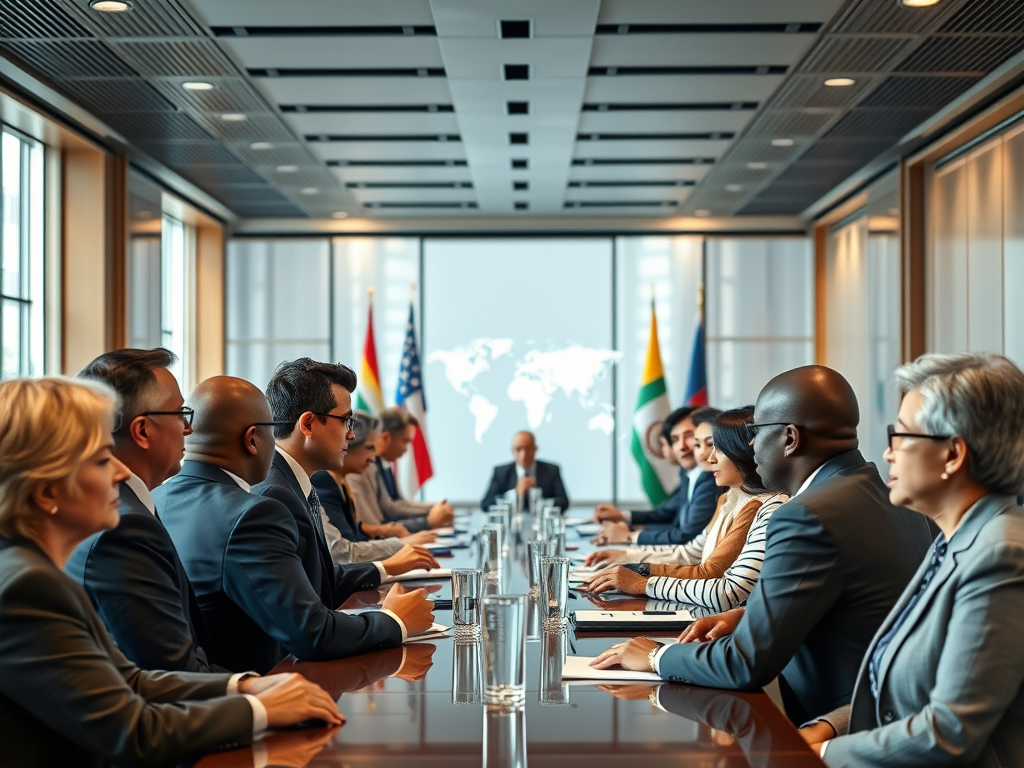
The idea of a new world council is both compelling and fraught with challenges. On one hand, existing institutions are clearly insufficient to address the scale and complexity of contemporary global issues. On the other hand, creating a new centralized body risks replicating the very problems it seeks to solve.
The answer may lie not in replacing existing institutions outright, but in transforming and integrating them into a more coherent and adaptive system. A world council could serve as a coordinating hub rather than an absolute authority—facilitating cooperation, setting standards, and providing mechanisms for accountability.
Its legitimacy would depend not only on its design but on its ability to deliver tangible benefits: conflict resolution, environmental protection, economic stability, and human well-being.
XI. A Vision for the Future
A transformative global order would differ from past iterations in several key ways:
- Legitimacy Through Inclusion: Power derived from diverse sources, not concentrated in a few states.
- Accountability Through Transparency: Decisions and processes visible and subject to scrutiny.
- Flexibility Through Decentralization: Adaptive structures that can evolve with changing conditions.
- Justice Through Redistribution: Addressing inequalities as a central priority.
- Sustainability as a Core Principle: Aligning governance with ecological limits.
Such a system would not eliminate conflict or competition, but it could channel them into constructive forms. It would recognize that power is not inherently illegitimate, but must be balanced by responsibility and constrained by law.
Conclusion
The history of “new world orders” is a history of ambition constrained by reality, of ideals compromised by power, and of structures shaped by the tensions they seek to resolve. The challenge today is not simply to design a better institution, but to rethink the underlying assumptions about power, sovereignty, and cooperation.
A new world council, if it is to succeed, must avoid the pitfalls of its predecessors: concentration of power, lack of accountability, and disconnection from the populations it serves. It must embrace complexity rather than simplify it, diversity rather than uniformity, and collaboration rather than domination.
Ultimately, the question is not whether humanity can create a perfect system—it cannot—but whether it can create one that is sufficiently just, resilient, and adaptive to navigate an increasingly interconnected and uncertain world. The answer will depend not only on institutional design, but on political will, cultural evolution, and the collective imagination of what a shared future can be.
— Adam Donaldson Powell
Leave a Reply