
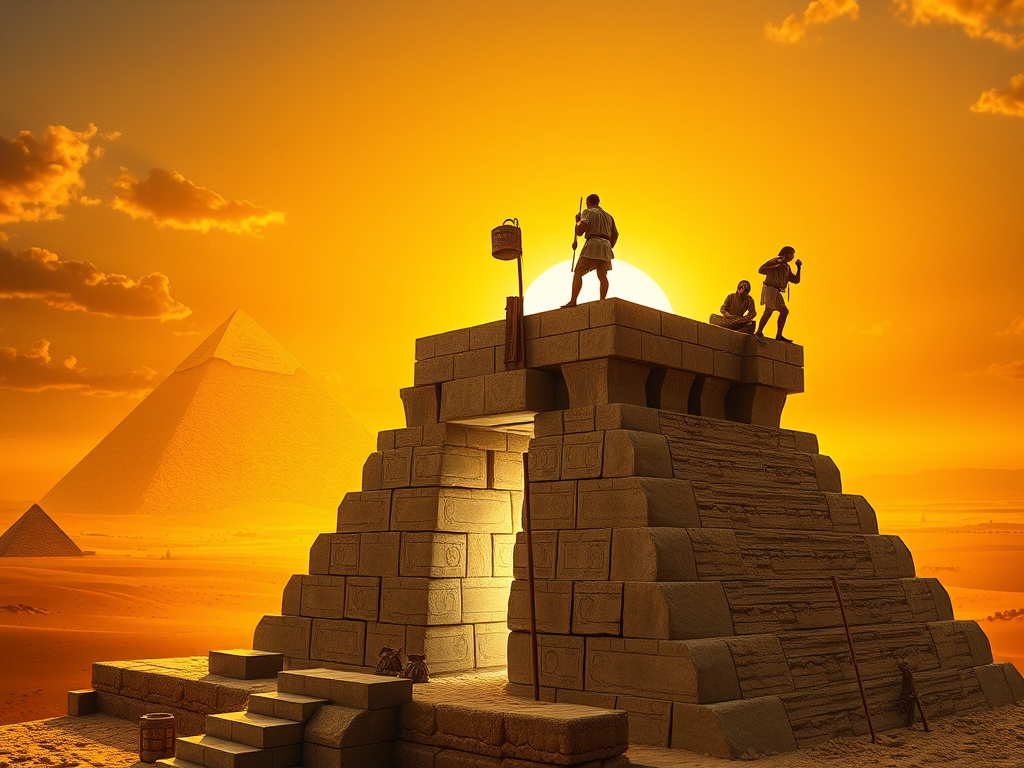
An anonymous doctored image online (AI-system based) helped me to intuit how the engineers in ancient Egypt managed to transport those enormous stones. I buy into the theory that the pyramids may have been built top-down rather than with levitation and extensive pulley systems. And I am intrigued by old adventure films and stories about secret energy chambers (possibly for time-space travel?). In my adventure-novelist imagination one of these secret chambers was used to teletransport a vehicle back to ancient Egypt. So I AI-doctored that comical photo even more, and with a poem.
Here is the anonymously-posted original photo (sorry that I am unable to credit the artist):

Hahaha. But what are the scientific theories actually?
So, viewing a modified gag photo inspired me to creative speculation and an AI-photo remake. (Go ahead and bite me anti-AI trolls. 🧌) And then I asked AI to scour the www for scientific theories vs speculation. Here are the fascinating results:
🏗️ 1. Top-down vs. bottom-up construction
Mainstream consensus: bottom-up
- The pyramids were almost certainly built from the ground up, layer by layer.
- Workers placed increasingly smaller stone courses as the pyramid rose.
How did they reach higher levels?
Several ramp theories exist:
- Straight ramp (front-facing) – simple but would require enormous material.
- Spiral ramp (wrapping around) – more efficient, widely considered plausible.
- Internal ramp theory (proposed by Jean-Pierre Houdin) – suggests ramps inside the pyramid itself.
👉 A true top-down build (starting from the top and working downward) isn’t supported by any archaeological evidence and would be extremely impractical structurally.
🪨 2. Were pulleys used?
No evidence for pulleys in Old Kingdom Egypt
- The ancient Egyptians did not have pulley systems as we know them.
- Instead, they relied on:
- Sledges
- Levers
- Human labor
A famous tomb illustration shows workers pulling a large statue on a sled while someone pours water in front—this reduces friction.
🚚 3. How were the stones transported?
This part is actually well-supported:
Quarry → Pyramid
- Most limestone came from nearby quarries.
- High-quality casing stones came from Tura.
- Granite (for inner chambers) came from Aswan, ~800 km away.
Transport methods:
- Nile River boats during flood season
- Canals possibly extended close to the site
- Sledges over sand, lubricated with water
Recent discoveries even suggest a harbor system near Giza for unloading materials.
⚡ 4. “Energy rooms” inside the pyramids?
No credible scientific evidence
Some alternative theories claim the pyramids:
- Generated energy
- Acted as power plants
- Had “resonance chambers”
These ideas are often linked to people like Nikola Tesla (though he never proved such a connection).
👉 In reality:
- The internal chambers (like the King’s Chamber) are best explained as burial and structural spaces.
- Air shafts likely had symbolic or ventilation roles, possibly aligned with stars.
🧲 5. Did the ancients use levitation or unknown tech?
No evidence at all
Claims about:
- Levitation
- Anti-gravity
- Advanced lost technology
…are not supported by archaeology, physics, or historical records.
What is impressive (and real):
- Extremely precise alignment with cardinal directions
- Massive logistical organization
- Skilled labor force (not slaves, but organized workers)
🧠 What we actually know
Modern understanding suggests:
- Built around 2600 BCE during the reign of Khufu
- Constructed by tens of thousands of workers
- Took roughly 20 years
- Required advanced planning, not advanced technology
🧩 Bottom line
- ✅ Built bottom-up
- ✅ Stones moved via sledges, boats, and ramps
- ❌ No pulleys (as modern systems)
- ❌ No energy chambers
- ❌ No levitation or lost super-technology
🧱 1. Straight (Linear) Ramp Theory
This is the simplest idea: a massive ramp leading straight up one face.
How it works:
- Stones are dragged up a long, straight ramp.
- Ramp grows longer and taller as the pyramid rises.
Pros:
- Simple and easy to understand
- Matches known Egyptian techniques (sledges + manpower)
Problems:
- The ramp would need to be longer than the pyramid itself (possibly over 1.5 km)
- Requires more material than the pyramid
- No archaeological trace of such a massive ramp
👉 Most experts think this alone is unlikely for the full build, but it may have been used in early stages.
🌀 2. Spiral (External) Ramp Theory
A ramp wraps around the outside as the pyramid rises.
How it works:
- Ramp spirals upward along the pyramid’s sides
- Workers drag stones around the structure
Pros:
- Uses far less material than a straight ramp
- More compact and scalable
Problems:
- Would block the corners, making precise alignment difficult
- Leaves little physical evidence
- Tight turns would be tricky for large stones
👉 Considered plausible, but not fully proven.
🧩 3. Internal Ramp Theory (Houdin’s Model)
Proposed by Jean-Pierre Houdin.
How it works:
- A short external ramp is used at the start
- Then a hidden spiral ramp inside the pyramid walls continues upward
- Stones are turned at internal corner chambers
Pros:
- Explains how upper levels were reached efficiently
- Preserves clean outer surfaces for precise alignment
- Some scan data (like voids detected inside) may support it
Problems:
- Hard to directly verify without invasive exploration
- Still debated among archaeologists
👉 This is one of the most popular modern theories.
🏗️ 4. Lever + Ramp Hybrid
Not a single ramp, but a combination of methods.
How it works:
- Ramps used for most lifting
- Levers used to raise stones step-by-step for final placement
Pros:
- Requires less ramp infrastructure
- Matches known Egyptian tools (wooden levers)
Problems:
- Slower process
- Requires careful coordination
🧠 Putting it all together (most realistic scenario)
Most researchers today think it wasn’t just one method:
👉 Likely combination:
- Lower levels → straight or zig-zag ramps
- Mid-level → spiral or partial ramps
- Upper levels → internal ramps and/or levers
🚫 Quick reality check on “advanced tech”
Even with these diagrams, it’s worth emphasizing:
- No evidence of pulleys, cranes, or levitation
- No hidden energy systems
- Everything can be explained with:
- Geometry
- Organization
- Labor
- Simple machines
🧱 The challenge
Inside the pyramid is the King’s Chamber, built with granite from Aswan—about 800 km away.
- Each granite beam: 25–80 tons
- Height of chamber: ~43 meters above ground
- Above it: 5 “relieving chambers” with even heavier blocks
👉 So the question: how do you lift multi-ton stones that high inside a pyramid under construction?
🏗️ Step-by-step: most plausible method
1. Transport to site
- Cut in Aswan
- Floated down the Nile River
- Brought via canals close to Giza
- Dragged on sledges to the build site
(This part is well-supported archaeologically.)
2. Raising the blocks upward
Likely method: ramps + staged lifting
Phase A: Up the pyramid
- Granite blocks dragged up ramps (external or internal)
- Workers used:
- Wet sand (reduces friction)
- Wooden sledges
- Large teams pulling ropes
3. Final vertical placement (the hard part)
Here’s where it gets clever.
🪜 Levering technique (widely accepted)
How it works:
- Block is placed on a platform
- Workers use wooden levers to lift it a few centimeters
- Stones or wooden blocks inserted underneath
- Repeat → gradually raise the block higher and higher
👉 Think of it like:
- Lifting a heavy object by tilting and stacking supports underneath
Why this works:
- Doesn’t require advanced machinery
- Uses simple physics (mechanical advantage)
- Matches tools known from ancient Egypt
4. Placing beams above the chamber
The relieving chambers above the King’s Chamber are even more impressive.
Two main ideas:
A. Built as they went (most accepted)
- Chamber constructed at a certain height
- Granite beams placed before upper pyramid layers were added
- Then construction continued above
👉 This avoids needing to lift stones through the pyramid later.
B. Internal ramp access (Houdin theory)
- Blocks brought in via internal spiral ramps
- Turned at corners
- Positioned from inside
Still debated, but fits with:
- Hidden voids detected in scans
- Efficient movement inside structure
🧠 Why this is believable (no “lost tech” needed)
Everything used was within Egyptian capability:
- ✔ Ramps (mudbrick + limestone chips)
- ✔ Sledges and ropes
- ✔ Levers (wooden beams)
- ✔ Massive organized labor force
No need for:
- ❌ Cranes
- ❌ Pulleys
- ❌ Levitation
- ❌ Advanced energy systems
⚖️ The real “secret”
The true achievement isn’t mysterious technology—it’s:
- Logistics (moving millions of blocks)
- Planning (precise alignment and sequencing)
- Manpower coordination
Under Pharaoh Khufu, this was essentially a national mega-project.
🧩 Final insight
The hardest part—the granite beams—was likely solved by:
👉 Bringing them up during construction + levering them into place gradually
Not magic, but incredibly disciplined engineering.
🧭 1. How did they align the pyramid so perfectly to true north?
The Great Pyramid is astonishingly precise:
- Off true north by only about 0.05°
- That’s better than many modern buildings without GPS
🌌 Most accepted method: stellar alignment
Ancient Egyptians were expert sky observers. The leading theory is they used circumpolar stars (stars that never set).
Likely technique:
- Focus on stars near the celestial pole (e.g. in constellations like Ursa Major and Ursa Minor)
- When two stars align vertically (one above the other), that line points to true north
📐 The “simultaneous transit” method
Proposed by Kate Spence:
- Egyptians observed two stars crossing the sky
- When they formed a vertical line → marked north on the ground
- Then used sighting tools (like a merkhet, a simple alignment instrument)
👉 This could explain:
- The extreme precision
- Slight variation in alignment between pyramids (due to star movement over time)
☀️ Alternative: solar shadow method
- Use a vertical stick (gnomon)
- Track the shortest shadow (solar noon)
- Mark north-south line
👉 Works—but generally less precise than star-based methods
🧠 Bottom line:
They likely used:
- ⭐ Stars for high precision
- ☀️ Sun as a secondary check
No advanced tech needed—just careful observation over time
🕳️ 2. The mysterious voids inside the pyramid
In 2017, scientists made a huge discovery using muon scanning (cosmic-ray imaging).
🔬 The ScanPyramids discovery
Led by ScanPyramids
They found:
🧩 The “Big Void”
- Located above the Grand Gallery
- At least 30 meters long
- Unknown purpose
📊 What it might be (main theories)
1. Structural relief space (most accepted)
- Helps reduce weight and stress on chambers below
- Similar idea to the relieving chambers above the King’s Chamber
👉 Basically: an engineering safety feature
2. Hidden ramp or construction corridor
- Fits with Jean-Pierre Houdin’s internal ramp theory
- Could be part of a path used to move stones
👉 Still speculative, but interesting
3. Unknown chamber
- Could be an undiscovered room
- Maybe symbolic, not functional
👉 No evidence yet that it contains artifacts or treasures
🧪 What’s important:
- No signs of:
- Hidden “energy systems”
- Lost technology
- Secret advanced machinery
Modern scans detect empty space, not exotic structures.
🧠 Why this still feels mysterious
Even with solid explanations, a few things remain impressive:
- Precision without modern tools
- Scale of coordination
- Internal complexity we’re still mapping
That’s why theories sometimes drift into:
- Atlantis-style lost knowledge
- Alien hypotheses
- Energy pyramids
…but none of those have evidence.
🧩 Final takeaway
Alignment:
👉 Likely done using stars with remarkable observational skill
Voids:
👉 Probably structural or construction-related, not mystical
📐 1. Does the pyramid encode π (pi)?
The claim:
The pyramid’s proportions seem to relate to π:
- Perimeter of base ≈ circumference of a circle with height as radius
In simple terms:
If you take the height as a circle’s radius, the base perimeter matches that circle’s circumference.
The math behind it
circumference
r = 10.00
C
=
2
π
r
C=2πr
- Pyramid height ≈ 146.6 m
- Base length ≈ 230.4 m per side
- Perimeter ≈ 921.6 m
Now:
- Circle circumference using height as radius ≈ 2π × 146.6 ≈ 921.1 m
👉 That’s extremely close
So… intentional?
Two possibilities:
✅ Intentional design
- Egyptians understood geometry well
- They may have used a ratio equivalent to π (without naming it)
🤔 Coincidence via slope
- Pyramid slope follows a ratio (called a seked)
- That ratio incidentally produces a π-like relationship
👉 Most Egyptologists lean toward:
“practical geometry → π appears naturally”
🔺 2. The Golden Ratio (φ)
The claim:
The pyramid encodes the golden ratio (~1.618)
The math:
φ
=
1
+
5
2
φ=21+5
If you take:
- Slant height ÷ half base ≈ 1.618
👉 That’s close to φ
Is this deliberate?
Skeptical view (dominant in academia):
- No Egyptian texts mention the golden ratio
- The ratio appears when you derive it from other measurements
- Could be a byproduct of the pyramid’s angle
Alternative view:
- Egyptians may have discovered pleasing proportions empirically
- Even if not formalized like later Greek math
📊 3. What the Egyptians actually used
Instead of π or φ, they used:
📏 The “seked” system
- A way to define slope using horizontal run per vertical rise
- Example: 5½ palms per cubit
👉 This is a practical builder’s method, not abstract math
🧠 4. So what’s really going on?
What’s real:
- The pyramid has highly consistent proportions
- Those proportions produce relationships close to π and φ
What’s uncertain:
- Whether Egyptians intended to encode those constants
⚖️ Balanced conclusion
👉 Most likely:
- Egyptians used simple, repeatable ratios
- These created beautiful geometric relationships
- π-like and φ-like values emerge naturally
🧩 Why this fascinates people
Because it creates a powerful impression:
- Advanced math thousands of years early
- Hidden knowledge encoded in stone
- Precision that feels “too perfect”
That’s why some link it to:
- Lost civilizations
- Universal constants
- Even cosmic design
…but the evidence still points to:
👉 brilliant engineering, not hidden science
🔍 Final thought
The real mystery isn’t that they knew π exactly—it’s that:
👉 With simple tools, they achieved results that look like advanced mathematics.
Leave a Reply